Many of Brahm's piano works are in fact accessible to an amateur, however the thing that I really like a lot - the Handel variations - unfortunately are too long and difficult for where I am now. But the Hungarian Dances, despite their popularity, are near and dear to my heart. So far I have learned to play two of them, number 5 and number 7, and am hoping to learn a couple more in the near future.
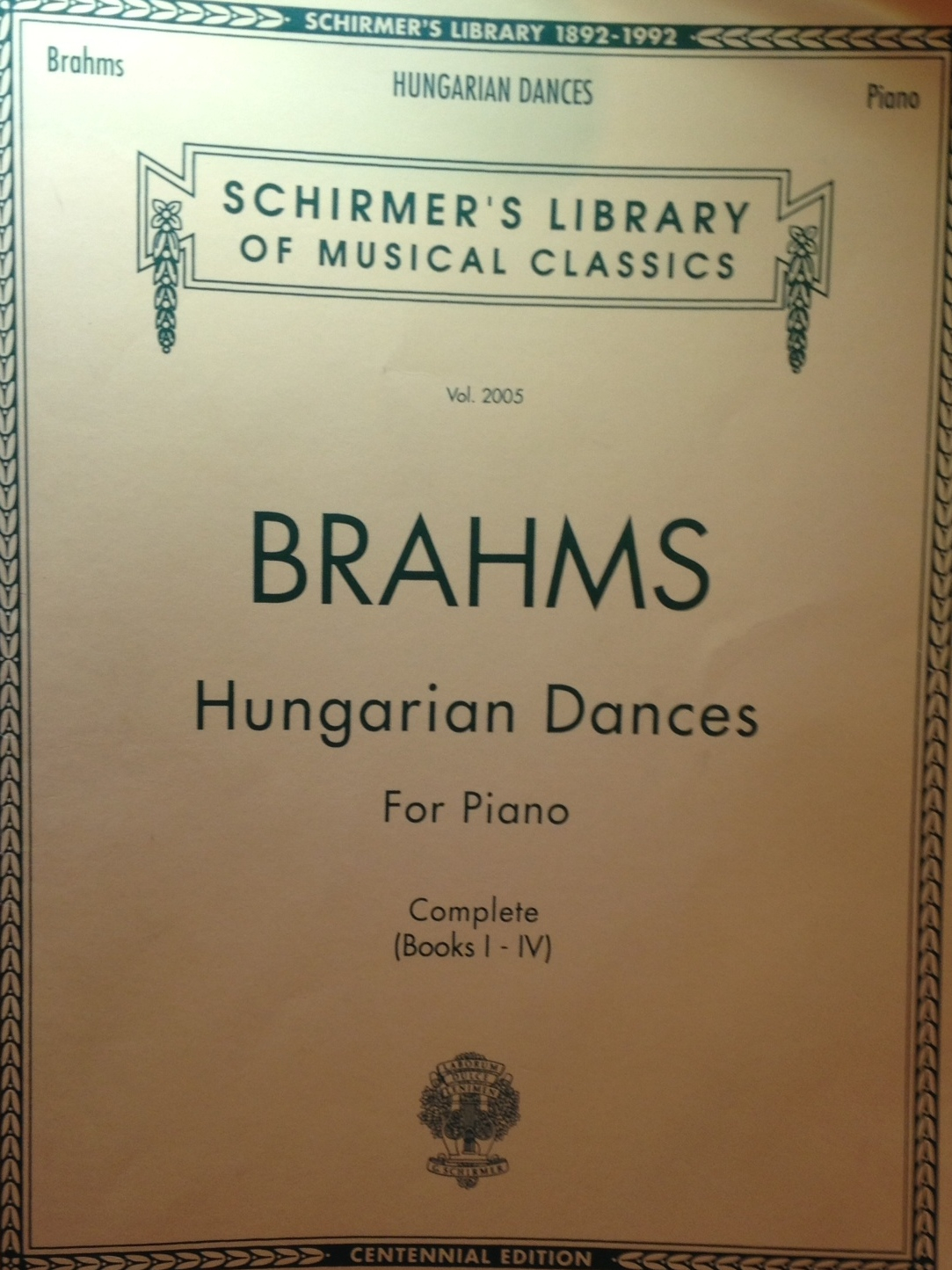
I started working on them about three years ago, in 2011. I remember that I wanted to play one of them as a birthday present to a friend of ours who definitely could use some encouragement at the time... and I told her that this music went through so many wars and revolutions and still sounds as if nothing happened, so she could perhaps manage to do the same. And to this day, when I play these pieces, for some reason I imagine this thin thread of culture, stretching from Brahms to us through all these 20th century horrors, telling us to disregard all that and carry on... Or maybe I just like Gypsy music?
In his teenage years, Brahms went on a tour with a Gypsy violinist (Edu Remenyi), accompanying him on the piano by ear (wow!) - so he had plenty of exposure to Gypsy tunes, and in his more mature years he arranged some of these melodies. At the time, it was popular to play piano "four hands" (two people playing side by side on the same keyboard, this by the way means that there were more good players than there were instruments to play), and first he arranged these pieces for that format and his friends were playing them at his house. After a while they convinced Brahms to publish the pieces, the first publisher he approached had rejected the manuscript, so he found another. The problem was that Brahms refused to call these pieces his own compositions and insisted they were arrangements of known melodies (indeed, he did not assign an Opus number to them). He reportedly said that these were his "genuine Gypsy children, which I did not beget, but merely brought up with bread and milk"... These adoptive children made a huge sum of money for the publisher, and even Brahms himself got comfortably rich from this publication (he is said to be the first composer ever to achieve this), and so he had plenty of incentive to continue in the same vein, and in 1872 he published the arrangements for solo piano - the text I'm using today...
Interestingly, the line that stretches from Brahms to us is not that long by historical standards - he lived long enough to see the phonograph, indeed there are recordings of him playing (from 1889). And of course there are many photographs of him, but instead I want to present two drawings which I stole from the link above:
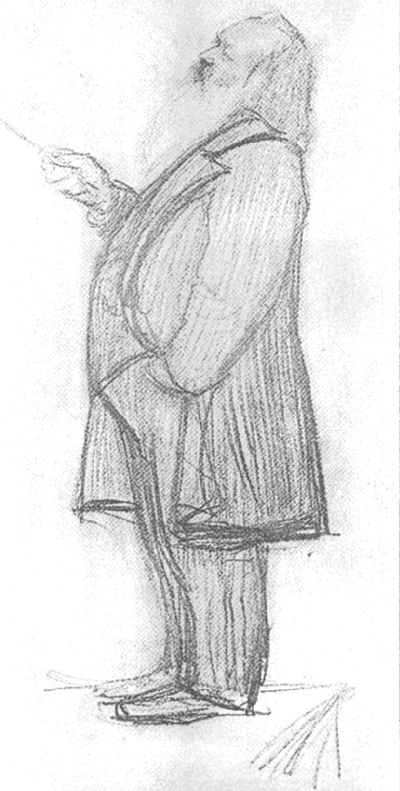

I think they might prepare you in some sense for what you are going to see in the videos...
OK, here's the dance number 7. The origins are reportedly in a melody played by a Gypsy band which Brahms had heard on a street in his native Hamburg. For most of the other pieces in this set it is known who the original composer was, but not for this one - it is one of the very few genuinely folk tunes. It is here where I feel this music teaches us "to disregard..." - I hope I was able to express that, even if just a little...
And here, for comparison - Kissin.
Now, the dance number five, probably the best known of this whole set. For this one, there is an established source, it's a czardash by Bela Keler, a Hungarian composer and conductor who was fairly well known at the time, judging by the title that piece was about reminiscences of his hometown. This piece is much more challenging technically (both hands have to do these leaps all the time), and is much longer, but emotionally I feel it's a bit simpler... in fact I have a feeling that it describes the state of mild inebriation, that's probably why I'm playing it a bit unevenly (and yet, at the very end, you can hear my dear wife praising my performance, of course this is barely audible...):
Here I was only able to find this YouTube performance by a young lady named Caroline Clipsham. With all due respect to her amazing skill, I think this is not how this piece should be played, all this virtuosity is totally uncalled for here (just listen to how any orchestra would play this). But if you want to get anywhere in the music world you have to show off like this so she has no choice. And I'd have the temerity to say something similar about Kissin, how he plays the previous piece - there's a passage towards the end of it (in my video it begins at the 1:36 mark) which Brahms says should be played Ad Libitum, which is as you please, but Kissin plays it so fast that it all just blurs into one thunderous roar, this shows off his virtuosity but is completely unnecessary music-wise.