My mother tells me that my father in his college years got deeply fascinated with classical music, and that Schubert was his favorite. I must have inherited that, because for me Schubert also stands out. He has this combination of classical elegance and romantic passion that I find nowhere else, and that resonates with something inside me. I also feel that there's something Russian in some of his music, for example the following Moment Musical was called "Air Russe" in some early editions. I dedicate this recording to my father, I was thinking of him when I was playing this, maybe he'll hear this somewhere in heaven and feel happy for me:
I got a recording where Murray Perahia plays Schubert's impromptus, and then another one where Alfred Brendel plays the same set of pieces. These two have the highest play count in my music library (although I very much like his other piano music, like many of the sonatas, and his symphonies are also among my favorites). There are actually two sets of impromptus, one is Op. 90 that everybody knows, and the other is Opus 142 (published posthumously) which I discovered from these recordings, and I still remember how deeply they moved me when I heard these pieces for the first time.
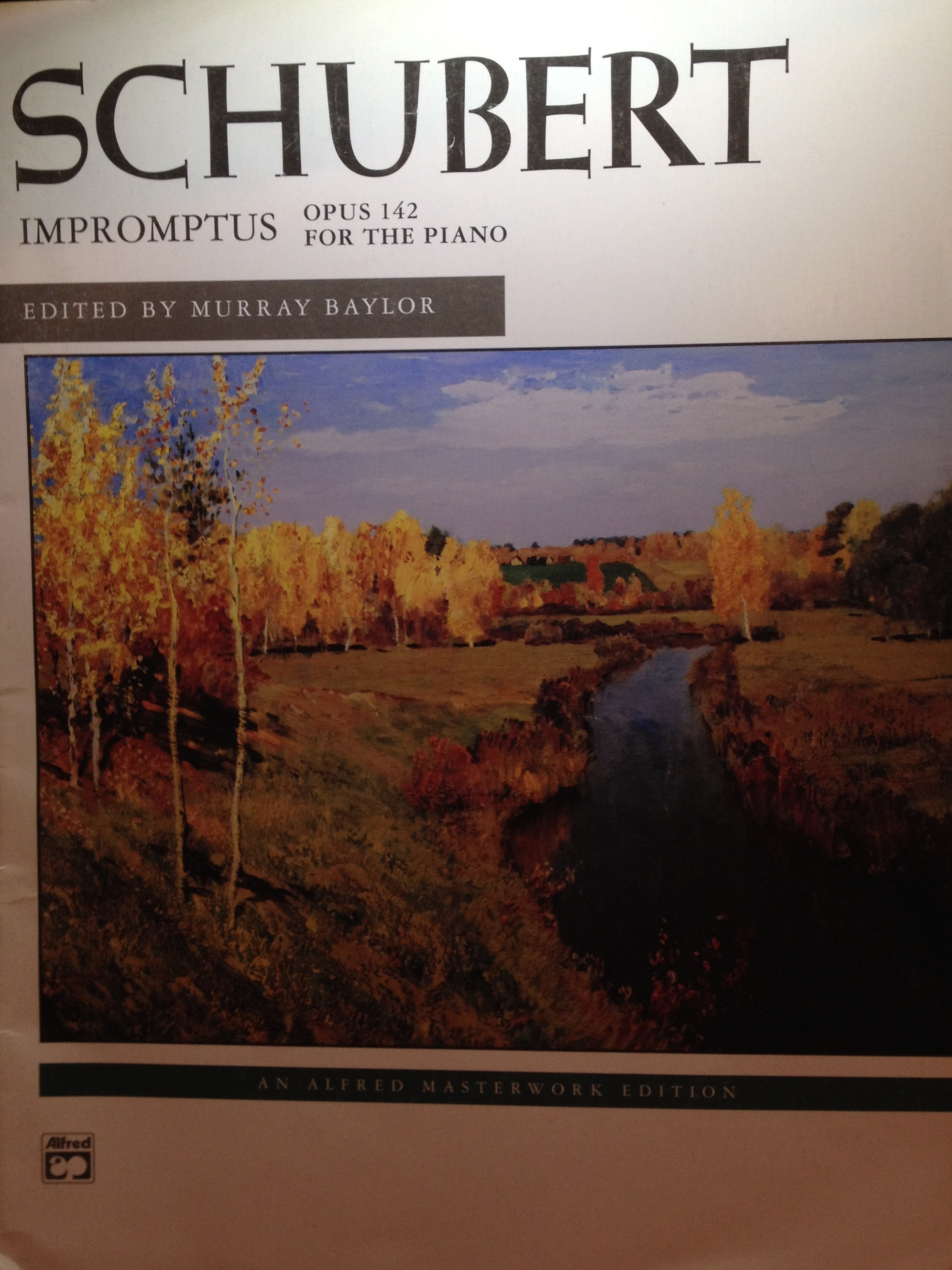
Of course I thought - can I play that? The honest answer is probably not... But still I tried, the first and the third of the Op. 142 set... the first starting probably in 2010, the third in 2012. This by the way was when I realized that some pieces simply cannot be played on my Yamaha piano -- too bright, and not nearly enough dynamic range. I did "correct" Schubert with the first impromptu, I decided not to play the second part where he repeats everything in F major, and combined the endings of the two pieces. Sorry, maybe some day I'll do the whole thing, as of now I just can't physically get through the whole piece. The third I try to play as written.
Both pieces are among the most difficult of anything I ever tried, both technically and also it's really hard to memorize something like this. I'm saying this so you do not judge me too harshly. Besides, I point out that these recordings are for training purposes really, that I was tired after work, that our batteries made a racket and one of my lamps kept flickering which distracted me hugely, and generally there are a lot of reasons why this sounds way worse than when Brendel plays it. But (and I hope you can see this in the videos) I must admit that playing this was an extremely satisfying experience, I can only hope you will enjoy at least parts of this:
The last Schubert's piece which I have left in my repertoire after this is the Serenade (Standhen) which I learned in Lizts's transcription. This famous piece is part of a longer set of songs called Schwanengezang (swan's songs), which were of course written for voice and not for the solo piano. After Schubert's death, Lizst did a lot to promote his music, and in particular he transcribed for piano much if not most of his lieder (songs). This particular cycle he transcribed in 1840, 12 years after passing of Schubert, and he actually wrote two versions of the transcription - one is simpler, in two parts (you'll see the notes where it says "ossia piu facile"), the other is more difficult (mostly due to fancier accompaniment), in four parts. What the children play in school is the first part of the simpler version. But I once heard Horowitz play the full thing and fell in love with it, and after several years of trying I give you this:
One of my cameras refused to record this so I had to use other means of making the video more lively, but the recording of the music itself is OK (although there's a buzzing sound when Eb of the small octave is played, some junk on the bookshelves around the piano buzzes on this note ONLY - search and destroy!). The lesson I take from this video is that hands (wrists) should be higher...
With this, I complete my Schubert efforts for now.